Ramírez’s multigenerational, migrant farmworker family inspired her life’s work. She often points to how her family’s story changed when farmers offered them a chance to stay in the rural Ohio town where she was born. That stability helped her parents move into work outside the industry and enabled Ramírez to attend school without having to do field labor herself, like her parents, grandparents, and uncles. “Just being able to break that migrant cycle made a big difference in terms of my life choices,” she says.
Ramírez believes the most effective way to bring people together is not through confrontation, but by building common ground.
At 14, she began writing for her local newspaper about issues affecting farmworkers and Latinos in her hometown. After college at Loyola University of Chicago, she earned a J.D. at the Ohio State University’s Moritz College of Law and a master’s in public administration from the Harvard Kennedy School.
Having grown up in a place where people get to know one another in school hallways, church pews, and grocery store aisles, Ramírez believes the most effective way to bring people together in today’s rural America is not through confrontation, but by building common ground.
Civil Eats spoke to Ramírez about how her work has evolved, the importance of humanizing food system workers, and the challenges facing farmworker activism today.
What was the narrative you wanted to shift by launching “The Humans Who Feed Us”?
I didn’t want to highlight the problems the farmworker community or immigrants face. I wanted to focus on their dreams, because that’s something that everyday people can relate to. My hope was that in creating the project that way, by having these portraits where you can see the individual and read some of their dreams on the cards alongside the portraits, the public would be able to connect with these individuals beyond their work, as people, and be able to say, “I share that dream.”
As you were learning their stories, what themes kept coming up?
Whether they’re fleeing violence or poverty, there was this idea that if they could come to the United States, it would be better. There’s a lot of gratitude. People are very grateful for the opportunities they’ve been given.
But there’s also this underlying theme that they want people to see them. They hear what people are saying about immigrants, and they want their neighbors to know that what they’re doing is for the good of many. They want to be seen and they want to be valued. A lot of them live in invisibility. They’re people who are going to work every day, doing work that literally sustains us. Whether they’re working in a grocery store, at a restaurant, a food truck, or far off in the fields, it’s like society has made them invisible.
What would you want the public to understand about the farmworkers and other communities behind our food?
That they are critical to our everyday lives. And that they’re more than just their work. These are whole people. They contribute in many ways.
Also, if you’re only focusing on their work, you fail to see all the other things that [as human beings] they need support with. It’s important for people to understand [their] struggle right now. There are so many rights that farmworkers and others who are employed in the food supply chain don’t have. Waiters and waitresses still have tipped wages. Members of the farmworker community still don’t have the right to overtime or the right to unionize under federal labor law.
We need consumers to see themselves as partners in this work. They need to be invested in improving the conditions. It’s been almost 90 years since the farmworker community and other food workers were denied the basic rights of other working people under the Fair Labor Standards Act. At the highest level of government, the decision has been made not to improve their rights over all these decades. We have to understand that as consumers and be partners in making the change. It’s not going to change if everyday people don’t get involved.
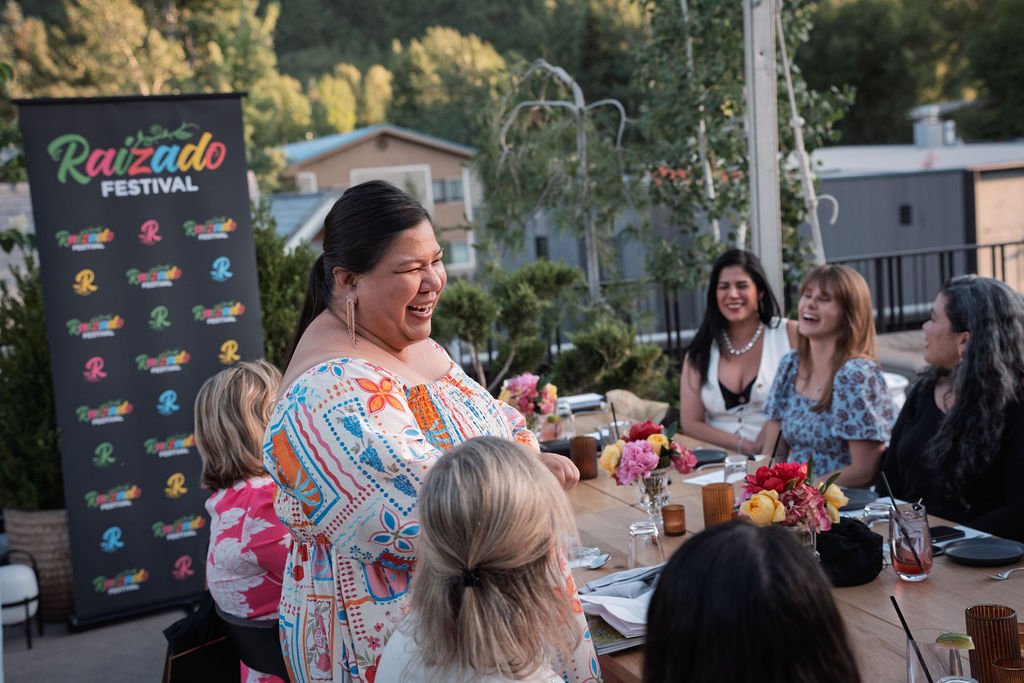
Mónica Ramírez at the Raizado Festival in Aspen, Colorado, in August 2025. Founded by Ramírez in 2020, the festival is a project of Justice for Migrant Women and celebrates Latine culture, leadership, and community. (Photo courtesy of Justice for Migrant Women)
How do you create common ground when having this discussion with someone who thinks differently? How does doing this advocacy work in rural America differ from in cities?
It really resonates when I talk about what it means to be a good neighbor. It doesn’t matter what your political affiliation is; that kind of language brings people together. We always look for words and ways where we can find common ground and bring people together, trying to connect human to human. That has been at the heart of what’s been successful in our work.
When you’re in a big city, it’s easier to find like-minded people. There’s just more people, and there’s a certain level of anonymity. Here in small-town Ohio, people I see at church or in the grocery store are people who we interact with every day. That’s a big difference between rural America and big cities, because we are not anonymous; people very much know who we are. That makes us a little bit more careful and thoughtful about what we say and do—and makes it a little bit easier to bring people of different political views together. We have had those kinds of bonds for years.
Source: civileats.com